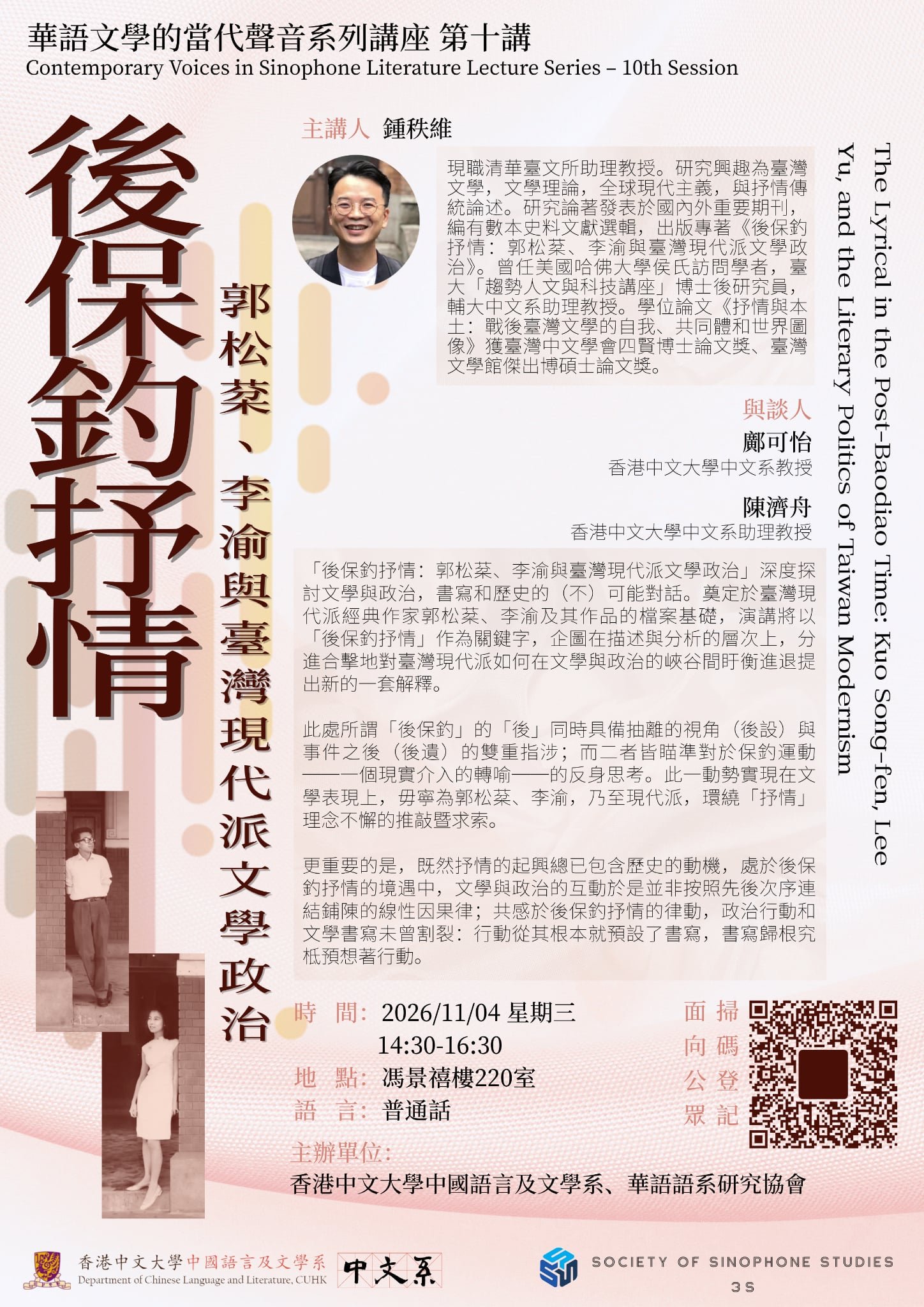
3S Co-sponsored Event: Contemporary Voices in Sinophone Literature Lecture Series – 10th Session
華語文學的當代聲音系列講座 第十講
Contemporary Voices in Sinophone Literature Lecture Series – 10th Session
【題目】後保釣抒情:郭松棻、李渝與臺灣現代派文學政治
The Lyrical in the Post-Baodiao Time: Kuo Song-fen, Lee Yu, and the Literary Politics of Taiwan Modernism
【日期 / 時間】2026年11月04日(周三)/ 下午 2:30- 4:30點
【地點】馮景禧樓220室
【與談人】
鄺可怡
陳濟舟
語言:普通話
【主辦單位】
香港中文大學中國語言及文學系
華語語系研究協會 (Society of Sinophone Studies)
【簡介】
「後保釣抒情:郭松棻、李渝與臺灣現代派文學政治」深度探討文學與政治,書寫和歷史的(不)可能對話。奠定於臺灣現代派經典作家郭松棻、李渝及其作品的檔案基礎,演講將以「後保釣抒情」作為關鍵字,企圖在描述與分析的層次上,分進合擊地對臺灣現代派如何在文學與政治的峽谷間盱衡進退提出新的一套解釋。
此處所謂「後保釣」的「後」同時具備抽離的視角(後設)與事件之後(後遺)的雙重指涉;而二者皆瞄準對於保釣運動──一個現實介入的轉喻──的反身思考。此一動勢實現在文學表現上,毋寧為郭松棻、李渝,乃至現代派,環繞「抒情」理念不懈的推敲暨求索。
更重要的是,既然抒情的起興總已包含歷史的動機,處於後保釣抒情的境遇中,文學與政治的互動於是並非按照先後次序連結鋪陳的線性因果律;共感於後保釣抒情的律動,政治行動和文學書寫未曾割裂:行動從其根本就預設了書寫,書寫歸根究柢預想著行動。
【主講人】
鍾秩維。現職清華臺文所助理教授。研究興趣為臺灣文學,文學理論,全球現代主義,與抒情傳統論述。研究論著發表於國內外重要期刊,編有數本史料文獻選輯,出版專著《後保釣抒情:郭松棻、李渝與臺灣現代派文學政治》。曾任美國哈佛大學侯氏訪問學者,臺大「趨勢人文與科技講座」博士後研究員,輔大中文系助理教授。學位論文《抒情與本土:戰後臺灣文學的自我、共同體和世界圖像》獲臺灣中文學會四賢博士論文獎、臺灣文學館傑出博碩士論文獎。
Contemporary Voices in Sinophone Literature Lecture Series – 10th Session
Title
The Lyrical in the Post-Baodiao Time: Kuo Song-fen, Lee Yu, and the Literary Politics of Taiwan Modernism
Date / Time
November 4, 2026 (Wednesday) / 2:30–4:30 PM
Venue
Room 220, Fung King Hey Building, CUHK
Discussants
Connie Kwong Ho-yee
Jannis Jizhou Chen
Language: Mandarin
Organizers
Department of Chinese Language and Literature, The Chinese University of Hong Kong
Society of Sinophone Studies
Abstract
"The Lyrical in the Post-Baodiao Time: Kuo Song-fen, Lee Yu, and the Literary Politics of Taiwan Modernism" undertakes an in-depth inquiry into the (im)possible dialogue between literature and politics, between writing and history. Grounded in the archives of Kuo Song-fen and Lee Yu, two canonical writers of Taiwan modernism, and of their works, the lecture takes "the post-Baodiao lyrical" as its keyword. Proceeding on the descriptive and the analytical levels at once, and converging from both fronts, it seeks to advance a new account of how Taiwan modernism gauged its advances and retreats within the ravine between literature and politics.
The "post" in "post-Baodiao" carries a double reference: a detached vantage point (the meta) and the condition of coming after an event (the aftereffect). Both are aimed at a reflexive thinking of the Baodiao movement, itself a metonym for intervention in the real. As this momentum takes shape in literary expression, it is nothing other than the tireless deliberation on, and pursuit of, the idea of the "lyrical" by Kuo Song-fen, Lee Yu, and indeed the modernists at large.
More significantly, since the lyrical impulse always already harbors a historical motive, the interaction between literature and politics under the condition of the post-Baodiao lyrical does not unfold according to a linear causality of sequence and consequence. Attuned to the rhythm of the post-Baodiao lyrical, political action and literary writing were never sundered: action presupposes writing from its very root, and writing, in the final analysis, anticipates action.
Speaker
Chung Chih-wei is Assistant Professor at the Institute of Taiwan Literature, National Tsing Hua University. His research interests include Taiwan literature, literary theory, global modernism, and the discourse of the lyrical tradition. His scholarship has appeared in leading journals in Taiwan and abroad; he has edited several anthologies of historical and documentary sources, and is the author of the monograph The Lyrical in the Post-Baodiao Time: Kuo Song-fen, Lee Yu, and the Literary Politics of Taiwan Modernism. He was previously a Hou Family Visiting Scholar at Harvard University, a postdoctoral fellow of the Trend Humanities and Technology Lecture at National Taiwan University, and Assistant Professor in the Department of Chinese Literature, Fu Jen Catholic University. His dissertation, The Lyrical and the Native: Self, Community, and the World Picture in Postwar Taiwan Literature, received the Si Xian Dissertation Award of the Taiwan Association of Chinese Literature and the Outstanding Dissertation Award of the National Museum of Taiwan Literature.