The 4th Biennial Conference
The Society of Sinophone Studies (3S)
The 4th Biennial Conference
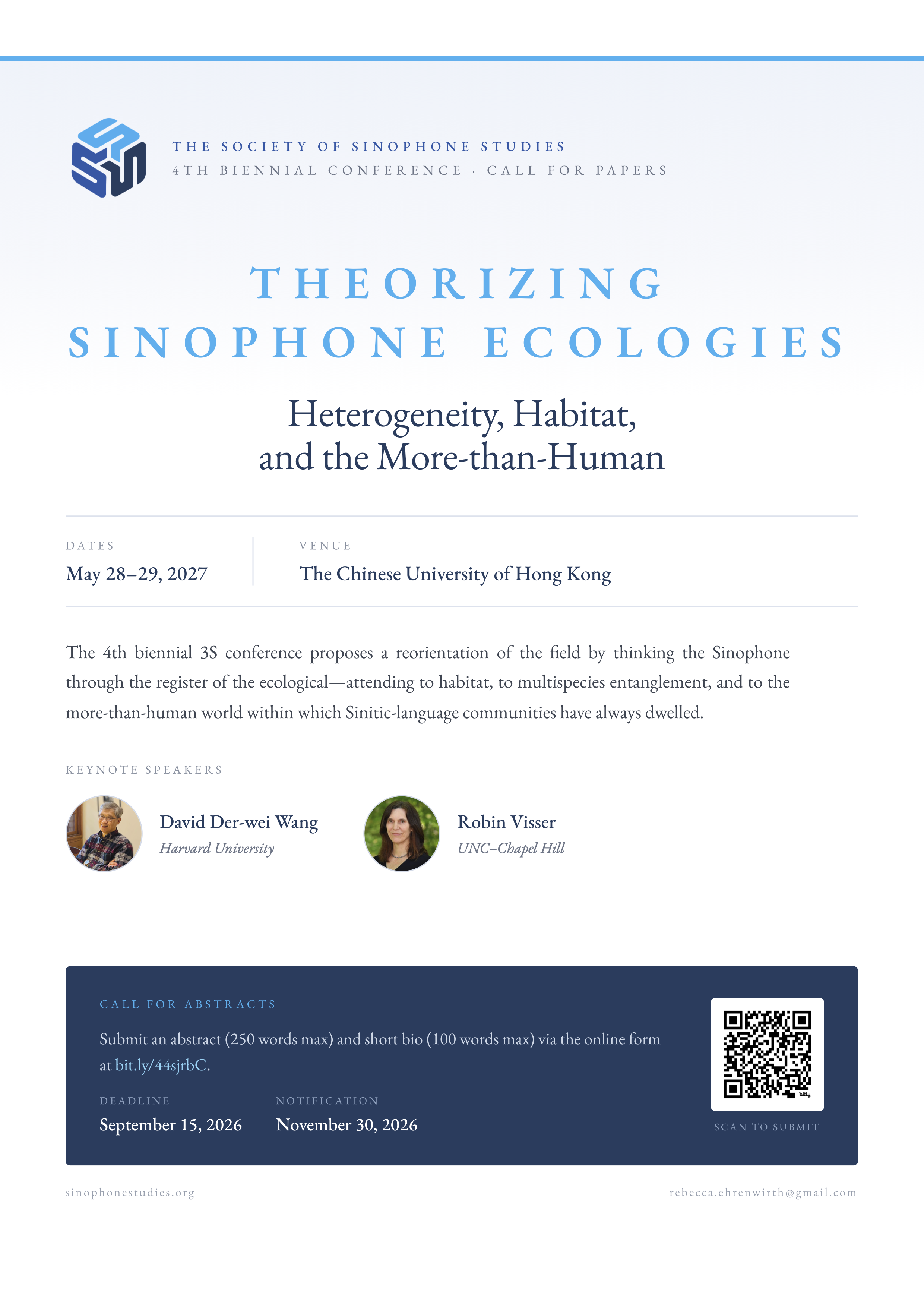
Theorizing Sinophone Ecologies:
Heterogeneity, Habitat, and the More-than-Human
May 28-29, 2027
The Chinese University of Hong Kong
Call for Papers
The 4th biennial 3S conference titled “Theorizing Sinophone Ecologies” will convene at the Chinese University of Hong Kong. It proposes a further reorientation of the field by thinking the Sinophone through the register of the ecological. The three previous 3S conferences have summoned “multisensory dissent,” “oceans and empires,” and the “engendering” of the Sinophone in order to expand the analytical scope of Sinophone studies beyond its founding coordinates. This conference further reorients the field’s intellectual genealogy by attending to habitat, to multispecies entanglement, and to the more-than-human world within which Sinitic-language communities have always dwelled.
From its inception, Sinophone studies has understood itself as a place-based practice. Shu-mei Shih’s insistence on the heterogeneity of Sinitic-language communities, and on their rootedness in the localities where they live rather than in an ancestral homeland, already carries an ecological intuition—languages and cultures take root, adapt, creolize, and sometimes wither in particular habitats. To theorize Sinophone ecologies is to take this intuition seriously, and at times literally. What happens when the “place” of place-basedness is understood not as territory but as habitat, not as bounded jurisdiction but as a mesh of relations among humans, animals, plants, fungi, minerals, waters, and weathers? The vocabularies of dwelling, relation, and situated knowledge may allow us to reopen the questions of borderland, ethnicity, and indigeneity that have animated the field from the beginning, at the very moment when the ecological and posthuman turn is reshaping humanistic inquiry across disciplines.
The Sinophone world offers abundant provocation for such a rethinking, for instance, the ecoliteratures of Taiwan and the continental borderlands, where non-Han and Indigenous writers narrate lifeworlds irreducible to the nation-form; the island and harbor imaginaries of Hong Kong; the plantation and rainforest fictions of Sinophone Southeast Asia; the disaster narratives, climate fictions, and eco-cinemas that now proliferate across and beyond these sites. Reading them together, we ask not only how Sinophone cultures represent nature, but how the ecological reconstitutes the Sinophone itself as an object of study. We invite papers from literary studies, film and media studies, the environmental humanities, Indigenous studies, and neighboring fields that explore these themes, including, but not limited to, the following questions:
· How does the ecological reframe the founding commitments of Sinophone studies to heterogeneity, multilingualism, and place-basedness? What would it mean to speak of a linguistic ecology of the Sinophone, in which Sinitic languages and scripts compete, hybridize, endure, and face extinction like species in a habitat?
· How might habitat and dwelling, as against territory and sovereignty, offer other ways of thinking the borderlands, from the highlands of Southwest China and the steppes and oases of Inner Asia to the plantations of the Nanyang and the reclaimed shorelines of Hong Kong? How do roots and routes appear differently when the ground itself becomes an actor?
· What do non-Han and Indigenous cosmologies, and their literary, cinematic, and artistic expressions, teach Sinophone studies about relation, personhood, and the limits of the human? How might they unsettle the Han-centrism and the anthropocentrism that so often travel together?
· What actors come into view when the more-than-human is taken seriously as a participant in Sinophone cultural production: animals and plants, stones and soils, rivers and typhoons, microbes and machines? How do things, materials, and elements bear witness, tell stories, or resist narration altogether?
· How do climate fiction, disaster narratives, and ecological documentary and cinema across the Sinophone world imagine planetary pasts and futures otherwise? What formal and generic innovations does ecological crisis demand of narrative, lyric, and the moving image?
· How do media technologies and infrastructures, from celluloid and electricity to extraction and energy, entangle Sinophone cultural production with geological and elemental processes? What might an elemental or geological media studies of the Sinophone look like?
· How does the oceanic inquiry of our 2023 conference extend inland and underground, to watersheds and deltas, aquifers and mines? How do the blue humanities and the environmental humanities converge, or diverge, in Sinophone contexts?
· How do gender, sexuality, and queerness, the concerns of our 2025 conference, intersect with ecological thought? What might queer ecologies, more-than-human kinship, and feminist science studies contribute to a Sinophone environmental humanities?
· What might Sinophone studies contribute to, and what should it resist in, the largely Euro-American genealogies of ecocriticism, posthumanism, new materialisms, and object-oriented thought? How might Chinese and Sinophone intellectual discourses on things, nature, and cosmos provincialize these frameworks, and be transformed in turn?
Submission Guidelines
The conference will be held in person at the Chinese University of Hong Kong on May 28 and 29, 2027, in a two-day, single-track format designed for sustained conversation. Keynote speakers are David Der-wei Wang (Harvard University) and Robin Visser (UNC-Chapel Hill). Please submit an abstract (no more than 250 words) and a short bio (no more than 100 words) via this Google Form by September 15, 2026. Notifications of acceptance will be sent by November 30, 2026, allowing ample time for travel and visa arrangements. If you are unable to access the Google Form through the hyperlink, you may copy and paste the following address into your browser: https://bit.ly/44sjrbC. Alternatively, you may submit your abstract and bio by emailing rebecca.ehrenwirth@gmail.com.
This conference will be hosted by the Department of Chinese Language and Literature at the Chinese University of Hong Kong, with additional institutional support from the Department of Comparative Literature and the Master of Arts in Literary and Cultural Studies (MALCS) program at the University of Hong Kong.
As an international nonprofit scholarly society operating on a modest budget, 3S regrets that it is unable to offer subsidies for travel or accommodation. We encourage participants to seek support from their home institutions.
The Society of Sinophone Studies (3S) is an international, nonprofit scholarly society founded on May 4, 2019. Our main goal is to promote the study of Sinitic-language communities and cultures around the world. Membership in 3S is open to anyone with an interest in Sinophone studies and any regional, disciplinary, and topical expertise. You can register for 3S membership at https://www.sinophonestudies.org/contact-us.
Members of the Conference Committee (alphabetical by surname)
Jannis Jizhou Chen (The Chinese University of Hong Kong)
Wendong Cui (The Chinese University of Hong Kong)
Rebecca Ehrenwirth (University of Applied Sciences/SDI Munich)
Carole Hang-fung Hoyan (The Chinese University of Hong Kong)
Erin Y. Huang (University of Toronto)
Connie Ho-yee Kwong (The Chinese University of Hong Kong)
Wen-chi Li (University of Bern)
Tim Shao-Hung Teng (The Chinese University of Hong Kong)
Alvin K. Wong (The University of Hong Kong)
Nim Yan Wong (The Chinese University of Hong Kong)